Showing posts with label desserts. Show all posts

Tuesday, July 16, 2013

cheesy delights


Creamy cheesecake with blueberry compote  


for the base

150g (5oz) Hobnobs, finely crushed
75g (3oz) butter, melted

for the filling

600g (1lb 5oz) cream cheese, at room temperature
1 heaped tbsp cornflour
150g (5oz) caster sugar
2 large free-range eggs and 1 egg yolk
1tsp vanilla extract
150ml (¼pt) crème fraîche
200g (7oz) blueberries
icing sugar, to decorate

for the blueberry compote

400g (14oz) blueberries
50g (2oz) caster sugar
1 strip lemon zest, removed with a peeler, and juice 1 lemon


Heat the oven to 180C, 160C fan, 350F, gas 4. For the base, place the biscuits and butter in a bowl, stir well and press into the base of the tin.

For the filling, place the cream cheese in a large bowl with the cornflour, caster sugar, whole eggs and egg yolk, and vanilla extract. Beat well with an electric whisk until thick and creamy. Beat in the crème fraîche, pour the filling over the biscuit base, then poke the blueberries into it. Place on a baking sheet in the centre of the oven and cook for 15 minutes, then lower the heat to 170C, 150C fan, 325F, gas 3 and cook for a further 30 to 40 minutes or until the outside is firm to the touch but the centre still has a good wobble.

Remove from the oven and run a round-bladed knife around the inside of the tin to loosen the cheesecake. Leave to cool completely in the tin, sitting on a wire rack so the air can circulate, then cover and chill overnight.

For the blueberry compote, place all the ingredients in a saucepan and cook over a gentle heat until the sugar has dissolved and the blueberries just burst with juices. Chill. To serve the cheesecake, remove from the tin, dust with icing sugar and serve with the compote on the side. The cheesecake will keep for 3 days, covered in the fridge.


Strawberry cheesecake with strawberry sauce


For the base:

175g (6oz) digestive biscuits, finely crushed
75g (3oz) butter, melted

For the filling:

225g (8oz) strawberries, hulled and halved
75g (3oz) caster sugar
2 gelatine leaves, softened in cold water
300g (10oz) cream cheese
150ml (1/4 pt) double cream, whipped
150ml (1/4 pt) natural Greek yoghurt

For the strawberry sauce:

450g (1lb) strawberries, hulled and halved
75g (3oz) caster sugar
Juice of ½ lemon
Extra strawberries to serve

Place the biscuits and butter in a bowl, mix well and press into the base of the tin. Chill whilst you make the filling.

For the filling, place the strawberries, 25g (1oz) of the caster sugar and 2 tbsp water in a saucepan and cook on a moderate until the strawberries are very soft. Puree the mixture in a blender and push through a fine sieve back into the saucepan that you cooked them in. Warm the strawberry puree again and when hot, squeeze the excess water from the gelatine leaves and add to the strawberry puree. Swirl the pan to make sure that the gelatine is completely dissolved. Set aside.

Place the cream cheese and remaining sugar in a mixing bowl and beat until smooth. Add the cooled strawberry and gelatine mixture and beat again. Add the yogurt and double cream and fold in until thoroughly combined . Pour over the biscuit base and chill for a minimum of 6 hours or overnight.

To make the strawberry sauce, place the strawberries, sugar and lemon juice in a bowl and leave to macerate for ½ hour. Puree the strawberries in a blender and push through a sieve. Chill until ready to serve.

To serve the cheesecake, run a round bladed knife around the outside of the tin and release the tin. Transfer the cheesecake to a serving plate. Decorate the top with a few halved strawberries and serve the sauce on the side. Your strawberry cheesecake will keep for 3 days, covered in the fridge.


Mocha rum cheesecake 


For the base:

175g (6oz) dark chocolate digestives, finely crushed
75g (3oz) butter, melted
½ tsp mixed spice

For the filling:

125g (4 ½ oz) dark chocolate
500g (1lb 2oz) cream cheese, at room temperature
125g (4 ½ oz) caster sugar
3 eggs
1 tbsp cornflour
1 tbsp coffee granules dissolved in 1 tbsp boiling water
150ml (1/4 pt) sour cream
2 tbsp dark rum

To decorate:

dark chocolate, coarsely grated, cocoa powder to dust and chocolate coated coffee beans (optional)


Heat oven to 150C, 130C fan, 300F, gas 2. For the base place the biscuits, butter and mixed spice in a mixing bowl, mix well then press into the base of the tin. Bake in the oven for 10 minutes, then remove and cool whilst you make the filling.

Melt the chocolate in a bowl over a pan of gentle simmering water, do not allow the base of the bowl to touch the water, stir occasionally then remove from the heat.

Place the cream cheese, sugar, eggs, cornflour, coffee and sour cream in a large mixing bowl and beat until smooth. Fold in the warm melted chocolate, stir well then finally add the rum, make sure everything is thoroughly combined

Pour the cheesecake mixture over the base. Give the tin a couple of sharp taps on the worktop to remove any air bubbles then smooth the top. Place on a baking tray and bake for 45 minutes to 1 hour or until the top is set but there is still a good wobble in the centre. Remove from the oven, run a round bladed knife around the outside of the cheesecake and place the whole tin on a wire rack to cool completely. Transfer to the fridge when cool and chill for a minimum of 6 hours or overnight.

To serve, run a knife around the outside of the cheesecake and release the tin. Scatter the surface with grated chocolate, chocolate coated coffee beans and a dusting of cocoa powder. The cheesecake will keep for 3 days, covered in the fridge.


Lime cheesecake 


For the base:

150g (5oz) digestive biscuits, finely crushed
75g (3oz) butter, melted

For the filling:

400g cream cheese
150g (5oz) caster sugar
2 eggs, separated
4 limes, zest finely grated and juice reserved
4 gelatine leaves, softened in cold water
200ml (1/3 pt or 7 fl oz) double cream

To serve:

Slices fresh mango and papaya
25g (1oz) shredded coconut, toasted


For the base put the biscuits and butter in a bowl, mix together well and press into the base of the tin, chill whilst you make the filling.

Place the cream cheese in a large bowl with 125g (4 ½ oz) caster sugar (reserve the remaining sugar for the egg whites), egg yolks and lime zest and beat together until smooth. Place the lime juice in a small saucepan and heat until just boiling. Remove from the heat, squeeze the excess water from the gelatine leaves and add to the pan. Swirl the pan to dissolve the gelatine completely. Leave to one side to cool slightly.

Whip the cream to soft peak stage. Whisk the egg whites until stiff then add the remaining sugar and whisk again until you have a thick, glossy meringue.

Add the cooled gelatine mixture to the cream cheese and beat well. Fold in the double cream and then the egg whites. Make sure everything is thoroughly combined. Pour over the chilled base. Give a couple of sharp taps on the worktop to remove any air pockets, and smooth the surface. Chill for a minimum of 6 hours or overnight.

To serve the cheesecake, run a round bladed knife around the outside of the cheesecake. Cut into slices with a hot, dry knife and serve with fresh mango and toasted coconut. The cheesecake will keep for 3 days covered in the fridge.


Baked dark cherry and almond cheesecake 


For the base:
175g (6oz) Hobnobs, finely crushed
75g (3oz) butter, melted

For the filling:

500g (1lb2oz) cream cheese, at room temperature
50g (2oz) ground almonds
100g (4oz) caster sugar
1 tsp almond extract
2 eggs plus 1 egg yolk
150ml (1/4 pt) sour cream
480g (1lb 1oz) bag frozen dark sweet cherries, defrosted and drained, juice reserved
25g (1oz) flaked almonds
Icing sugar to decorate

For the compote:
The remaining cherries approx 250g (9oz), defrosted
1 tbsp caster sugar
Juice of ½ lemon


Heat oven to 170C, 150C fan, 325F, gas 3. Place the biscuits and butter in a bowl, stir well then press into the base of the prepared tin. Bake in the oven for 10 minutes, then remove and leave to cool.

Place the cream cheese in a large mixing bowl, add the ground almonds, sugar, almond extract, eggs and egg yolk and beat until smooth. Add the sour cream and beat again. Pour over the biscuit base and give a couple of sharp taps on the worktop to remove any air bubbles.

Take half the cherries and scatter them over the cheesecake. They will sink just below the surface. Finally scatter the flaked almonds over the top. Place the tin on a baking sheet and bake for 45 minutes -50 minutes. The top should be golden brown and firm around the outside but with a good wobble in the centre. Remove from the oven, run a round bladed knife around the outside of the cheesecake and leave to cool. When cold, transfer to the fridge for several hours or overnight.

For the cherry compote, place all the ingredients in a saucepan with 2 tbsp water and any reserved juices and heat gently until the sugar has dissolved and the cherries are soft but still retain their shape. Leave to cool

To serve the cheesecake, dust the top with icing sugar, slice and serve with a spoonful of cherry compote on top.


Seville orange cheesecake 


For the base:

150g Digestive biscuits, finely crushed
75g (3oz) butter, melted

For the filling:
250g (9oz) cream cheese
100g (4oz) caster sugar
2 eggs, separated
2 oranges, zest finely grated, and juice of 1 orange
3 gelatine leaves, soaked in cold water
3 rounded tbsp Seville orange marmalade
200ml (1/3 pt or 7fl oz) double cream


Place the biscuits and butter in a bowl, stir well then press into the base of the tin, chill whilst you make the filling.

Place the cream cheese in a mixing bowl and beat until smooth. Add 50g (2oz) sugar, the egg yolks and orange zest and beat again until smooth and creamy.

Place the orange juice in a small saucepan and bring up to a boil, remove from the heat. Squeeze the excess water from the gelatine leaves, add to the hot orange juice and swirl the pan until the gelatine is dissolved. Pour onto the cream cheese mixture, beating well. Stir in the marmalade. Lightly whisk the cream to soft peaks and fold into the cream cheese mixture. Whisk the egg whites until stiff, add the remaining 50g (2oz) sugar and whisk again until thick and glossy. Fold into the cream cheese mixture then pour over the biscuit base. Give a couple of sharp taps on the worktop to remove any air pockets, then smooth the surface. Chill for a minimum of 6 hours or overnight.

To serve, run a round bladed knife around the outside of the tin to release the cheesecake. Cut into slices with a hot dry knife and serve with extra orange segments if desired.


Baked New York vanilla cheesecake 


1½ packets Hob Nob biscuits, crushed
100g (4oz) melted butter
250g (9oz) caster sugar
800g (1lb 12oz) cream cheese
pinch of salt
2tbsp pure vanilla extract
3 large eggs

For the topping

450ml (15fl oz) soured cream
25g (1oz) caster sugar
2tsp pure vanilla extract
some fresh blueberries, to serve


Preheat the oven to 180 C, 160 C fan, 350 F, gas 4. Cross over two long strips of lightly oiled foil in the tin to remove the cheesecake.

Start this delicious cheesecake recipe by mixing together the Hob Nobs, butter and 50g (2oz) of the sugar. Line the bottom and sides of the cake tin with this mixture, pushing it into the corners, but not thickly (make a mitten out of clingfilm so the crumbs stick to the tin, not to your hands). Store it in the fridge while you make the filling.

Whip the cream cheese with an electric mixer. When soft and fluffy, add the remaining sugar and whisk again. Add salt and vanilla and beat once more. Slowly add the eggs one at a time. Pour this mixture into the lined cake tin and place on a baking sheet.

Bake for 1 hour 10 minutes until the cheesecake is set but still has a slight wobble. Allow to sit at room temperature (the risen cheesecake will sink a little during this time) while you make the topping.

Whisk together the soured cream, sugar and vanilla and pour over the cheesecake. Return to the oven for a further 10 minutes. Put it in the fridge as soon as it's cool enough. Gently heat the blueberries in a little water until they're glossy and serve with the cheesecake as a compote.


Strawberry, chocolate and Amaretti cheesecake 


250g (9oz) Amaretti biscuits
100g (4oz) lightly salted butter, melted
100ml (4fl oz) double cream
200g (7oz) white chocolate, chopped into very small pieces
300g (10oz) cream cheese
250g (9oz) mascarpone
¼tsp vanilla bean paste
400g (14oz) strawberries, halved
icing sugar, to taste
1tsp lemon juice


Double-line a 24cm (9½in) springform cake tin with clingfilm. Whizz the Amaretti biscuits in a food processor and pour in the butter until you have well-coated fine crumbs. Press the crumbs into the base of the cake tin. Chill.

Meanwhile, place the cream over a double boiler and heat until it begins to steam. Tip in the chocolate, turn the heat off and leave until melted. Stir to incorporate the cream.

Whisk the cream cheese, mascarpone, vanilla and chocolate together for about 30 seconds until you have a smooth, shiny mixture. Spoon this on to the biscuit base.

Chill for at least two hours. Purée a handful of the strawberries, sieve and stir through the icing sugar and lemon juice to taste. When the cheesecake is ready to be served, remove from the tin and peel off the clingfilm carefully. Transfer to a serving plate, pile the strawberries up in the centre with and dust with icing sugar, and serve with the sauce on the side.


Chocolate, hazelnut and Amarula cheesecake 


For the base

200g (7oz) chocolate Hobnob biscuits, crushed
50g (2oz) toasted hazelnuts, chopped
60g butter, melted

For the filling

200g (7oz) dark chocolate, broken into squares
100ml (4fl oz) double cream
2 eggs
85g caster sugar
500g (1lb 2oz) cream cheese
chilled Amarula liqueur (or you can use Baileys or any other cream liqueur), to serve


Lightly grease the bottom and sides of the tin and line the sides with baking parchment. Mix together the Hobnobs, hazelnuts and butter in a bowl and squash into the base. Place in the fridge.

Preheat the oven to 150 C, 130 C fan, 300 F, gas 2. Put the chocolate and cream into a heatproof bowl set over a pan of gently simmering water and leave to melt. In a separate bowl, whisk the eggs and sugar with an electric hand whisk until pale and thick. Beat in the cream cheese, then fold in the melted chocolate and cream. Spoon onto the chilled base and smooth flat. Place on a baking sheet in the preheated oven and cook for 1 hour or until just set but slightly wobbly in the middle. Leave to cool completely, then remove from the tin and slide onto a serving plate.

Pour the Amarula into chilled shot glasses and your guests can either use it as a sauce for the cheesecake or simply drink it as a shot.


P.S. Enjoy and remember to use organic ingredients :-)

Friday, June 28, 2013

little delights


Wild plum fool with sponge fingers


300g wild plums, toned and cut into wedges
75g caster sugar
200ml double cream

For the custard:
2 large free-range egg yolks
20g caster sugar
1/2 tsp vanilla bean paste or extract
100ml double cream
100ml whole milk

For the sponge fingers (makes approx. 30):

3 large free-range eggs, separated
90g caster sugar
75g plain flour
6 tbsp icing sugar

For the custard, whisk the egg yolks, sugar and vanilla together in a bowl until thick and pale. Bring the cream and milk to the boil in a non-stick pan, then whisk into the yolk mixture. Return the lot to the pan and stir over a low heat until the mixture thickens and coats the back of a wooden spoon. Pour into a bowl and leave to cool, then chill for at least 4 hours.

Put the plums or damsons into a pan with the sugar and stir over a medium heat until the juices start to run, then increase the heat and cook for about 5 minutes, stirring occasionally, until cooked. Rub the mixture through a sieve into a bowl. Cool, then cover and chill along with the custard.

For the sponge fingers, preheat the oven to 180°C/Gas 4. Beat the egg whites in a large clean bowl into soft peaks. Whisk in the caster sugar, one teaspoon at a time, to make a stiff and glossy meringue. Lightly beat the egg yolks and gently fold into the meringue, then sift over the flour and fold in. Spoon the mixture into a piping bag fitted with a 1cm plain nozzle and pipe 2cm wide strips in 8-10cm long lines across two large lined baking sheets, leaving 5cm between each one. Dust with half the icing sugar and leave to rest for 5 minutes, then dust with the remaining icing sugar and bake for 10 minutes. Leave to cool, then store in an airtight tin until needed.

To serve, whip the cream in a large mixing bowl until it just begins to form soft peaks. Gently fold in the custard and plum purée until only just mixed. Spoon into a serving bowl and serve with the sponge fingers for dipping.


Pistachio and orange shortbread hearts 


60g unsalted pistachios, shelled
225g unsalted butter, softened
100g caster sugar, plus extra for sprinkling
225g plain flour, plus extra for dusting
60g semolina
zest of 1 orange, finely grated

Whizz the pistachios in a food processor until finely chopped and tip into a bowl. Add the butter, caster sugar, flour and semolina, and using your fingers rub the butter into the dry ingredients Add the grated orange zest and work until the mixture comes together

Turn the dough out onto a lightly floured work surface and knead very gently until smooth. Shape the dough into a ball, flatten into a disc, wrap in cling film and chill in the fridge for 30 minutes

Lightly dust the work surface with flour and roll out the dough to a thickness of about 4mm. Using heart-shaped cutters, stamp out cookies and arrange on lined baking trays. Gather any dough off cuts into a ball and re-roll to make more cookies. Chill the cookies for a further 30 minutes

Meanwhile preheat the oven to 170C/325F/Gas Mark 3

Bake the cookies on the middle shelf of the oven for about 15-18 minutes or until very pale golden

Remove from the oven, sprinkle with caster sugar and then transfer to wire racks to cool


Ricotta tartlets with fig and honey 


250g ricotta
2tbsps sugar
8 digestive biscuits
2 large ripe figs, quartered lengthwise
Honey

Preheat oven to 200C or soften the biscuits in the microwave for about 20 seconds to save time

Combine ricotta and sugar in a small bowl

If using oven, place biscuits on a baking tray in the oven for 2 minutes

Remove from the oven or microwave. Using a soup spoon and a tea towel, carefully shape the biscuits into little tartlet shells

Repeat with the remaining biscuits

Divide ricotta mixture equally between tartlet shells

Top each with a fig quarter and drizzle with a little honey.


Rhubarb and orange crumbles 


50g (2oz) cold butter, cubed
75g (3oz) flour
25g (1oz) coarse oatmeal
25g (1oz) caster sugar
350g (12oz) rhubarb, cut into 2cm (¾in lengths)
zest 1 orange, plus 1tbsp juice
2 balls stem ginger, finely chopped
40g (1½oz) light muscovado sugar


Heat the oven to 190C, 170C fan, 375F, gas 5. To make the crumble, rub the butter into the flour until it resembles coarse breadcrumbs. Stir in the oatmeal and caster sugar, and set aside.

To make the filling, in a small bowl, mix the rhubarb, orange zest and juice, stem ginger and muscovado sugar. Divide equally between the ramekins or jars and top with the crumble mix. Place on a baking sheet and cook in the oven for 20 to 25 minutes or until the topping is golden. Serve with clotted cream, if you like.


Sticky toffee tots 


for the sauce
125g (4½oz) dark soft brown sugar
60g (2½oz) unsalted butter
150ml (¼pt) double cream
½tsp sea salt flakes

for the sponge

85g (3½oz) stoned dates, chopped
½tsp bicarbonate of soda
40g (1½oz) unsalted butter, softened
85g (3½oz) caster sugar
2 large free-range eggs
½tsp pure vanilla extract
125g (4½oz) self-raising flour, sifted


To make the sauce, place the sugar, butter, cream and salt in a saucepan and heat gently, stirring, until the sugar has dissolved and the sauce is smooth. Set aside to cool and thicken.

Heat the oven to 180C, 160C fan, 350F, gas 4. To make the sponge, place the dates in a bowl with the bicarbonate of soda and 150ml (¼pt) boiling water. Stir well and set aside.

Beat the butter and caster sugar in a food processor until fluffy. Beat the eggs with the vanilla extract and pour in a steady stream on to the butter and sugar, beating continuously. Don't be alarmed if the mixture looks curdled at this stage - it will all come together when you add the flour.

Add the flour and beat well, then pour in the dates and all the liquid; mix well. Butter the dariole moulds and divide the mixture evenly between them - they should be just over two-thirds full. Place on a baking sheet in the middle shelf of the oven.

Bake for 15 to 20 minutes or until well risen and golden brown. Press the centre of the puddings lightly; if the sponge springs back, they are cooked. Remove from the oven and allow to rest for 5 minutes before turning out on to 6 warmed plates. To serve, pour a couple of spoonfuls of the sauce over each pudding and serve the rest in a jug.


Raspberry and elderflower shortbread 


85g (3½oz) plain flour
35g (1¼oz) caster sugar
75g (3oz) cold unsalted butter, cubed
100g (4oz) raspberries
25ml (1fl oz)elderflower liqueur
200ml (1/3pt) double cream
1 tsp icing sugar, to dust


Preheat the oven to 180C/160C fan/350F/Gas 4. Place the flour, caster and butter in the bowl of a food processor whiz until it resembles breadcrumbs.

Pulse until it comes together to form a ball then carefully remove from the processor bowl. Dust the surface with flour and roll out the shortbread to 6mm (¼in) thick. Using a 3cm (1¼in) fluted cutter punch out rounds and transfer to a lined baking tray.

Bake for 10 minutes until just turning golden. Leave to cool completely.

Crush raspberries with a fork and stir through the elderflower liqueur. Lightly whip the cream then fold through the raspberries. Spoon a little of the raspberry cream onto each of the shortbreads and sandwich with a another shortbread. Dust with icing sugar to serve.


Petite apple pies 


125g (4½oz) plain flour
75g (3oz) cold, unsalted butter, cubed
35g (1¼oz) caster sugar, plus extra to sprinkle
1 free-range egg yolk, plus 1 beaten egg, to glaze
3 large Bramley apples (around 750g/1lb 10oz), peeled and roughly chopped
¾tsp ground cinnamon
75g (3oz) caster sugar

To make the pastry, mix the flour, butter and sugar along with a pinch 
of salt in a food processor until it resembles fine breadcrumbs. Add the egg yolk and a little cold water, and pulse until it comes together to form a dough. Bring it together with your hands and roll flat with a rolling pin into a disc shape. Chill in the fridge for 1 hour. Heat the oven to 190C, 170C fan, 375F, gas 5.
To make the filling, mix the apples, cinnamon and sugar together, then divide equally between the ramekins. Roll out the pastry to the thickness of a £1 coin, and cut into discs slightly wider than the ramekins. Brush the lip of each ramekin with a little water and lay the pastry over the top; trim the overhang so it sits neatly against the edge. Cut a steam hole, decorate the top with the extra pastry and sprinkle with sugar. Brush with the beaten egg and bake for 25 to 30 minutes or until golden. Serve with custard or cream.


Strawberry brownie bites


100g (4oz) butter
100g (4oz) dark chocolate
2 medium eggs
½ tbsp vanilla extract
125g (4½oz) caster sugar
50g (2oz) plain flour
Pinch salt
200g (7oz) Silver Spoon strawberry flavour buttons
Sugar craft edible flowers, to decorate

Preheat oven to 180C/160C fan/350F/Gas 4. Grease and line a 20cm (8in) square cake tin with baking parchment.

Melt the butter & chocolate together. Cool slightly then beat in the eggs, sugar & vanilla. Fold in flour and salt then pour into the prepared tin.

Bake for 15-20 minutes until the brownies are set but still gooey. Leave to cool in the tin for 10 mins before turning out onto a wire rack to cool completely.

Slice the brownie into 36 x 3cm (1¼in) squares.

Melt the buttons according to pack instructions then spoon over the brownies and leave for an hour to set. Top with the edible flowers to serve.


Mini bakewells 


175g (6oz) plain flour
100g (4oz) cold, unsalted butter, cubed
40g (1½oz) caster sugar
1 large free-range egg yolk

for the filling

50g (2oz) unsalted butter, softened
50g (2oz) caster sugar
1 large free-range egg and 1 yolk, beaten
60g (2½oz) ground almonds
zest and juice ½ lemon
½tsp vanilla extract
2tbsp raspberry conserve
20g (¾oz) flaked almonds


To make the pastry, mix the flour, butter and sugar along with a pinch of salt in a food processor until it resembles fine breadcrumbs. Add the egg yolk and a little cold water, and pulse until it comes together to form a dough. Bring it together with your hands and roll flat with a rolling pin into a disc shape. Chill in the fridge for 1 hour.

Heat the oven to 180C, 160C fan, 350F, gas 4. Roll out the pastry to the thickness of a £1 coin, and cut into discs to fit the bun tin moulds. Carefully shape to fit neatly, then prick the bottoms lightly with a fork. Line each with a small piece of foil and fill with baking beans. Blind bake for 20 minutes.

To make the filling, cream the butter and sugar until pale and creamy; then gradually beat in the egg and egg yolk, a little at a time. Fold in the ground almonds, lemon zest and juice, and vanilla. Set aside.

Remove the pastry cases from the oven, take out the beans and set aside to cool. Add a small amount of the
jam to the pastry cases and top with the almond filling - don't overfill. Sprinkle over the flaked almonds and bake for 10 to 15 minutes or until lightly golden.


Chocolate and pistachio biscotti 


350g (12oz) plain flour, plus extra for dusting
50g (2oz) cocoa powder
1 tsp baking powder
pinch salt
300g (10oz) caster sugar
200g (7oz) dark chocolate, chopped into small chunks
125g (4½oz) shelled pistachios
3 large eggs, lightly beaten, plus 2 egg yolks
½ tbsp vanilla extract

Preheat the oven to 180C/160C fan/350F/Gas 4. In a large bowl mix the flour, cocoa powder, baking powder, salt, sugar, chocolate chunks and pistachios.

Pour over the eggs, egg yolks and vanilla. Mix well and bring together to a soft smooth dough.

With floured hands divide into two logs about 30cm (11¾in) long and 6.5cm (2½in) wide & high, place on two separate baking sheets. Bake for 30 minutes until set on top then leave to cool for 10 minutes.

Reduce the oven temperature to 150C/130C fan/300F/Gas 2. With a serrated knife cut each log on the diagonal into 1cm (½in) thick slices. Lay the biscotti cut side down on the baking sheets and bake for another 20 minutes, turning the biscotti over halfway through. Leave to cool completely on a wire rack.


Triple berry cheesecakes 


100g melted butter
2 tbsp runny honey
200g digestive biscuits, finely crushed
1 tsp ground cinnamon
For the cheesecake
6 gelatine leaves (I use Supercook Platinum)
100ml blueberry purée
100ml raspberry purée
100ml strawberry purée

(if you can’t find berry purées, make your own by puréeing fresh berries in a blender and passing them through a fine sieve)

620g full-fat cream cheese
185g caster sugar
210g crème fraîche
640ml double or whipping cream


Line the insides of the dessert rings or mousse moulds with the acetate strips.

To make the biscuit base, melt the butter with the honey in a saucepan. Add the crushed biscuits and cinnamon and mix until combined. Carefully press a tablespoonful of the biscuit mixture into the bottom of each mould, keeping the sides as clean as possible.

To make the cheesecake, place the gelatine leaves into a bowl and soak them in cold water. Gently warm each of the fruit purées separately, squeeze the water from the gelatine leaves and dissolve two leaves in each of the hot fruit purées. Set aside to cool.


Place the cream cheese and caster sugar in a bowl and mix together until smooth and combined. Then add the crème fraîche. Whip the cream to a soft-peak consistency, taking care not to overwhip.


Divide the cream cheese mixture into three equal parts. Once the fruit purées have cooled to room temperature, mix each one separately with a third of the cream cheese mixture, using a whisk. From this point, you must work quickly as the gelatine can set.

Divide the whipped cream into three equal parts. Gently fold through each of the three cream cheese mixtures until combined.

Starting with strawberry, followed by raspberry and then blueberry, layer the three fruit mixtures in the lined rings or moulds. I find it easier and neater to use piping bags to create the different layers. However, if you do not have piping bags you can carefully spoon the mixtures into the moulds instead.

If using piping bags, fill a plastic piping bag with each mixture. Snip 2.5cm (1in) from the tip of the bag and pipe a layer over the bottom of the biscuit base to about halfway up the sides. Repeat for the two other fruit mixtures until you reach the top.

Flatten the top layers with a palette knife or the back of a spoon. Chill for at least 4 hours or until set.

You can make these cheesecakes up to 3 days in advance if stored in the fridge. De-mould and remove the acetate strips just before serving.


Marshmallow puffs 


280ml water
6 sheets gelatine
620g caster sugar
130g glucose
70g egg whites (approximately 2 large eggs), at room temperature
Pinch of salt
Seeds of 1 vanilla pod
Pink, purple and green liquid food colour


Place the gelatine in a saucepan with 130mlof the water. Leave to soak for 10–15 minutes. Gently warm the gelatine until the leaves have dissolved. Alternatively, dissolve the gelatine by microwaving it in short bursts on a low–medium heat

Place 320g of the caster sugar and the glucose in a small saucepan with the remaining water. Gently warm over a low heat until the sugar has dissolved, then turn up the heat and bring the syrup to the boil.

Using a sugar thermometer, measure the temperature of the syrup. When the syrup reaches 115°C, place the egg whites in a mixing bowl with the dissolved gelatine and salt and start whisking. Once the syrup reaches 121°C, slow down the whisking and carefully pour the syrup into the egg whites in a thin steady stream – pour down the side of the bowl so that the syrup does not splash onto the whisk.

Once all the syrup has been incorporated 
into the egg whites, continue whisking 
quickly until the marshmallow has cooled to room temperature. Once the marshmallow has cooled, add the vanilla seeds.

For a combination of colours, divide the mix into equal parts and fold the liquid food colour through with a spatula.Place each coloured mixture into a separate piping bag using a rubber spatula.Cut approximately 2.5cm (1in) from the tip of the bag and pipe the marshmallow into the greased moulds. Leave to dry for several hours.

In the meantime, make the coloured sprinkling sugars. Divide the remaining caster sugar evenly between 3 bowls and mix each with a few drops of liquid food colour, matching the colours of the marshmallows. Sift out any lumps before use.

Once the marshmallows are fully set, remove them from the moulds and roll in their coordinating sprinkling sugars. Leave the marshmallows to dry uncovered overnight before packing into airtight containers. The marshmallows can be stored like this for up to 5 days.


P.S. remember to use organic ingredients and enjoy your desserts :)

Tuesday, June 11, 2013

coffee delights


Espresso mousse with Frangelico cream


150g (5oz) good-quality dark chocolate, roughly chopped
4 free-range eggs
4tsp espresso coffee powder dissolved in 1tsp hot water
150ml (¼pt) double cream
3tbsp icing sugar, sifted
3tbsp Frangelico (hazelnut liqueur)
hazelnuts and melted chocolate, to decorate (optional)


To make the mousse, melt the chocolate in a heatproof dish over simmering water, then set aside to cool slightly. Separate 3 of the eggs, whisk the egg yolks with the final whole egg and add the coffee before beating into the melted chocolate. In a clean bowl, whisk the 3 remaining egg whites to soft peaks. Fold into the chocolate mix until evenly combined. Spoon into glasses or ramekins and chill for at least 90 minutes.

To make the Frangelico cream, whip together the cream, icing sugar and Frangelico and spoon over the set mousses. If you like, decorate with hazelnuts dipped in chocolate.


Tiramisu cupcakes


100g (4oz) unsalted butter, softened
100g (4oz) golden caster sugar
1tsp vanilla extract
1½tbsp instant coffee granules
2 large free-range eggs, lightly beaten
100g (4oz) self-raising flour, sifted
cocoa powder, for dusting (optional)

for the masala frosting

75g (3oz) full-fat cream cheese
250g tub mascarpone cheese
1-2tbsp Marsala wine
3tbsp icing sugar, sifted


Heat the oven to 180 C, 160 C fan, 350 F, gas 4. Beat the butter, sugar and vanilla extract together until light and fluffy. Add a couple of drops of water to the coffee granules and mix to form a thick paste. Stir this into the mix until well combined.

Gradually beat in the eggs, then fold in the flour with a pinch of salt.

Divide the cake mix between the paper cases, place in the middle of the oven and bake for 12 to 15 minutes, until springy to the touch and lightly golden on top. Remove the cupcakes from the muffin tin and cool on a wire rack.

To make the Marsala frosting, beat the cream cheese, mascarpone, Marsala and icing sugar in a large bowl until smooth. Transfer to a piping bag and pipe swirls on to each cake. Dust with cocoa powder, if using.


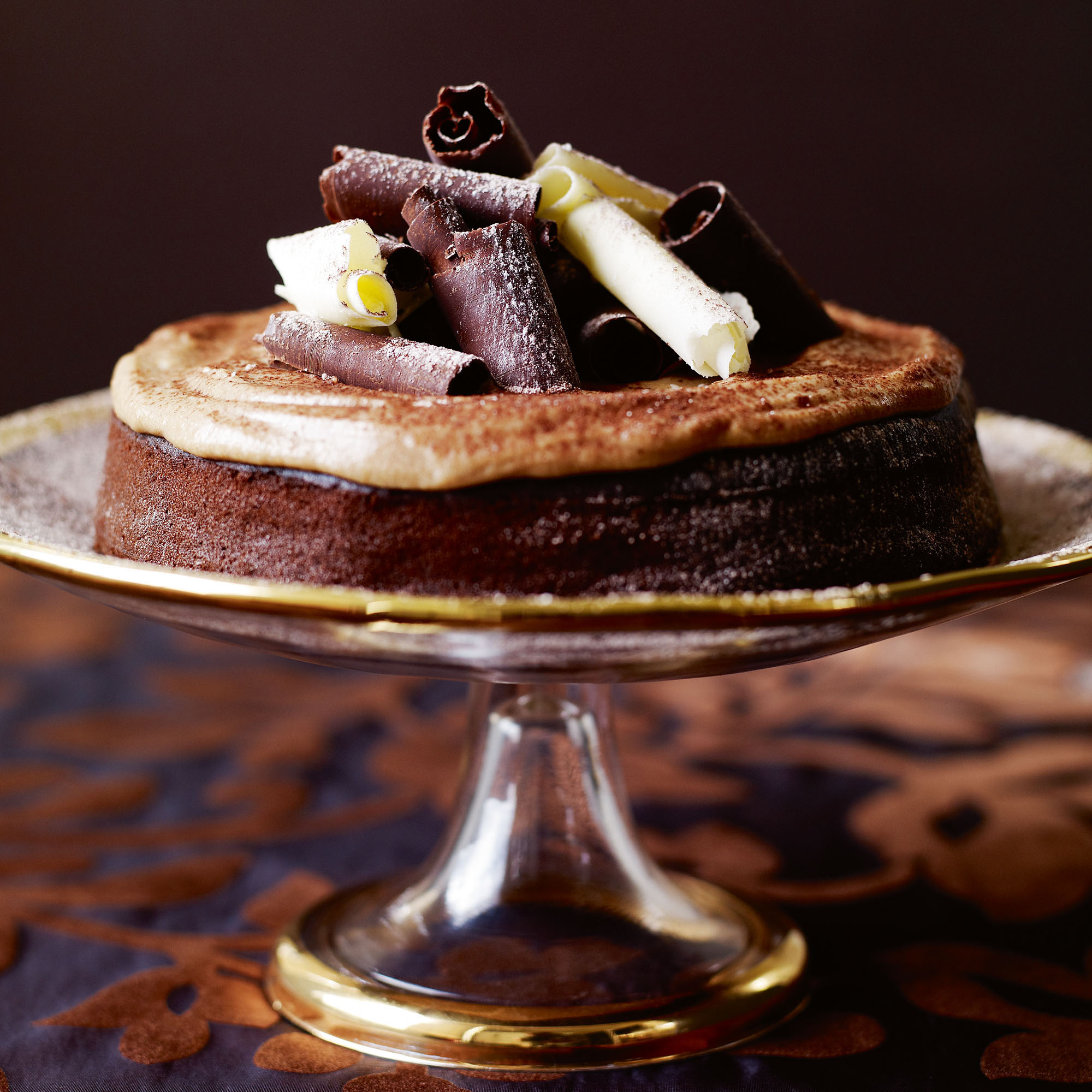
Sticky mocha cake with chestnut cream 


175g (6oz) organic self-raising flour
25g (1oz) organic/fair trade cocoa
2tbsp Kahlua
200g (7oz) organic unsalted butter
185g (61⁄2oz)organic  light soft brown sugar
250g (9oz) organic/fair trade dark chocolate
350ml (12fl oz) organic/fair trade strong black coffee
2 large free-range eggs, beaten
250g (9oz) organic chestnut purée
3tbsp organic double cream
white and dark chocolate curls, cocoa and icing sugar, to decorate (organic/fair trade)


Heat the oven to 180 C, 160 C fan, 350 F, gas 4. Sift the flour and cocoa powder into a bowl with a large pinch of salt. Place the Kahlua, butter, sugar, dark chocolate and coffee in a saucepan and cook over a low heat until melted. Allow to cool for 5 minutes, then stir in the eggs. Stir the wet ingredients into the dry until well combined, then transfer to the prepared cake tin and bake in the centre of the oven for 45 minutes, until a skewer inserted into the middle comes out clean. Remove from the oven and cool in the tin for 10 minutes, then cool completely on a wire rack. It will crack, but that's normal.

While the cake is cooling, whip the chestnut purée with the double cream until smooth. When the cake is cool, spread the chestnut cream on top in a thick layer, pile the chocolate curls in the middle and dust with a mixture of cocoa and icing sugar.


Coffee Pavlova with cappuccino cream


4 egg whites
200g (7oz) caster sugar
1tsp white wine vinegar
1tsp coffee essence, such as Camp
1tbsp cornflour

For the creamy filling

300ml (½pt) double cream, lightly whipped
4tbsp Greek yogurt
50g (2oz) dark chocolate, finely chopped
50g (2oz) pecan nuts, toasted and roughly chopped
1tbsp coffee essence

To decorate

50g (2oz) pecan nuts, toasted and roughly chopped
maple syrup and cocoa powder


Preheat oven to 110 C, 90 C fan, 225 F, gas ¼. Beat the egg whites until stiff. Add the sugar gradually, whisking all the time until thick and glossy. You should be able to turn the bowl upside down without the meringue moving. Fold in the vinegar, coffee essence and cornflour. Line 2 baking sheets with baking parchment, using a bit of meringue to stick it down. Divide mix into 8, making a small dip in the centre, then bake for 1 hour. Switch off oven and leave to cool for a few hours.

For the cream filling, mix all the ingredients together. If it is a little stiff, just add a touch of unwhipped cream to thin it down.

To serve, place a Pavlova on a plate, top with a dollop of cream, scatter over the pecans, drizzle over the syrup and dust with cocoa.


Coffee and walnut cake


150g (5oz) unsalted butter, softened
150g (5oz) caster sugar
3 large eggs, beaten
150g (5oz) self raising flour
1/2tsp baking powder
2tsp coffee granules dissolved in a little boiling water
50g (2oz) walnuts, roasted and chopped


For the coffee syrup

2tbsp light Muscovado sugar
1tbsp coffee granules mixed with 2tbsp boiling water and 1tbsp Camp coffee essence


for the coffee buttercream

50g (2oz) unsalted butter, softened
100g (4oz) icing sugar, sifted
2tsp coffee granules mixed with 1tbsp boiling water

for the coffee glacé icing

75g (3oz) icing sugar, sifted
2tsp coffee granules mixed with 1tbsp boiling water
75g (3oz) walnut pieces for decoration

Preheat oven to 180 C, 160 C fan, 350 F, gas 4. Place the butter and caster sugar in the bowl of an electric mixer and beat for 5 minutes until very pale and creamy.

Gradually add the eggs a little at a time, beating continuously until all incorporated.

Sift together the flour and baking powder and gentle fold into the butter mixture along with the dissolved coffee and the walnuts.

Divide the mixture evenly between the tins, smoothing the top with a palette knife. Bake on the centre shelf of the oven for 20 to 25 minutes or until well risen and golden brown. The cakes can be frozen, un-iced, for up to one month. Defrost and ice before serving.

While the cakes are baking, make the coffee syrup. Place all the ingredients in a bowl and stir until it has all dissolved.Pour the coffee syrup evenly over both sponges while they are still in the tins. Allow the cakes to cool completely before turning out on to a wire rack.

To make the coffee buttercream, place the softened butter in the bowl of an electric mixer, add the sifted icing sugar and dissolved coffee, and beat until smooth. If the icing is a little stiff then add a few more drops of boiling water until you have a spreadable consistency.

For the finishing touch, make the glacé icing. Place the icing sugar and dissolved coffee in a bowl and beat until smooth, adding more boiling water until you have a glossy, spreadable consistency.

To assemble the cake, place one cake on a large plate, spread over the coffee buttercream and sandwich with the other cake. Be careful not to let it break.

Spread the glacé icing over the top and decorate with the walnut pieces


P.S. remember to use organic ingredients and enjoy your dessert :)